
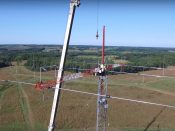
There are many sorts of novice radio reception apparatuses on the grounds that authorized ham radio administrators (Hams) have many groups and a large number of conceivable frequencies they can use for two way radio correspondence.
Most Hams today pass a basic examination which enables them to begin in the leisure activity with a VHF versatile radio which works in the two meter band. These 2m handsets transmit at around 146 MHz, so a little reception apparatus functions admirably for them.
Other novice Radio Antenna Masts appreciate the energy of long range radio, talking over the shortwaves to different hams around town, in different urban areas or in different nations. They require a beginner radio reception apparatus that is substantially bigger, in light of the fact that the radio flags there vibrate at a lower (and more) recurrence. Furthermore, a transmitting recieving wire dependably needs to reverberate (or coordinate) the recurrence of the flag it is sending.
So ham radio recieving wires for the shortwave groups change from wire aerials that are more than 200 feet long to perhaps 66 feet or something like that. What’s more, vertical reception apparatuses or towers can go up forty feet or all the more straight open to question. All these diverse two way radio aerials have distinctive qualities and shortcomings in store.
Certain beginner radio transmitter recieving wires are phenomenal for long range work, others for short range or for versatile or convenient utilize. At that point there are bar radio wires, which move their energy one way and smother signals at their back and sides. These pillar radio wires should be mounted on a pole or a pinnacle so they can be pivoted and pointed toward whatever path is required that day.
There are three primary outlines for bar recieving wires. These are yagi reception apparatuses, quad radio wires and broadband log-occasional dipole recieving wires. Yagi reception apparatuses might be single band or multi-band outlines, and would he be able to HF, VHF or UHF. The 14 MHz (20m band) is normally the most reduced ham band they cover, particularly in 3 or 4 band yagi radio wire outlines. Quad radio wires on the HF groups generally have only two components and can be multi-united. There are cubical quads and arachnid quad plans. (On the vhf groups, a quad radio wire littler than HF, so it may have four components. In any case, yagis are more typical for vhf and uhf groups.) On the HF groups, log-occasional recieving wires are truly vast – so they are more typical with government international safe havens and the military. Hardly any hams have the cash or the land for such expansive shortwave recieving wires.